Discovery of 3,800-year-old artifact mentioned in Bible story
Historians of ancient times have uncovered a rare relic that appears frequently in the Old Testament of the Bible.
Archaeologists recently have discovered an ancient cave in Israel where humans lived over 100,000 years ago.
This reddish-colored dye was created from insects' carcasses and eggs, which were then crushed to make a powder used for dyeing clothes.
The textile showcased woolen threads dyed red, which were woven interwoven with uncolored linen threads to create a lattice-like pattern.
The Israel Antiquities Authority made the discovery on Thursday, after finding a less than two-centimeter textile hidden in the 'Cave of Skulls' in the Judean Desert.

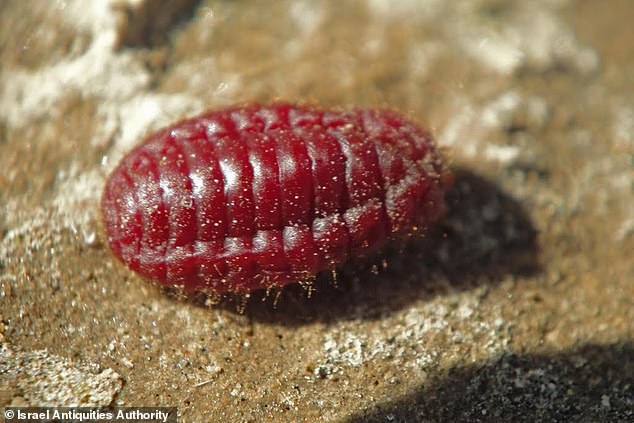
The "scarlet worm" mentioned in the Bible is a type of scale insect that resides in oak trees, with the primary species from ancient times being Kermes.
Females and their eggs produce carminic acid, which is responsible for the dye's distinctive red color.
People would gather bugs, sprinkle them with vinegar to preserve them, allow them to dry out, and then grind their bodies into a powder used for dyeing cloth and clothing.
The red range, from orange to pink and crimson, has held substantial historical symbolism and significance, the team stated in the study published in the peer-reviewed Journal of Archaeological Science.
'The red color derived from these scale insects, based on molecules such as kermesic acid or carminic acid, is both stable and aesthetically pleasing, making them significantly more desirable compared to vegetal dye sources.'
This scarlet dye is also known as shani or tola'at shani in Hebrew, meaning "crimson worm," and appears extensively in the Old Testament.
According to Leviticus 14:16: "As for the living bird, he shall take it, and the cedar wood, and the scarlet, and the hyssop, and shall dip them and the living bird in the blood of the bird that was slaughtered over the flowing water."

The deep red color is also mentioned occasionally in Exodus, notably in Chapter 26, verse 1: 'Make the tabernacle with ten curtains of finely twisted linen and blue, purple, and crimson-colored yarn, with cherubim woven into them by a skilled craftsman.'
The use of 'Kermes' is also mentioned in a Stockholm papyrus, which contains 154 recipes for dyeing, coloring gemstones, cleaning pearls and imitating gold and silver.
The manuscript originates from a period dating far back in time.
The crimson dye derived from kermes was also referenced in ancient trade documents, including cuneiform tablets originating from Mesopotamia, dating back to around 1425 BC.
The team found the ancient textile in Israel, discovering a plant-based substance from the southern Levant that was used to produce the fibers, and the weaving threads were created from wool.
This textile is a weft-faced tabby, with roughly 50 threads per centimeter in the weft system and approximately 10 threads per centimeter in the warp, as stated by the study.
The warp threads are more loosely arranged, whereas the weft threads are tightly packed.
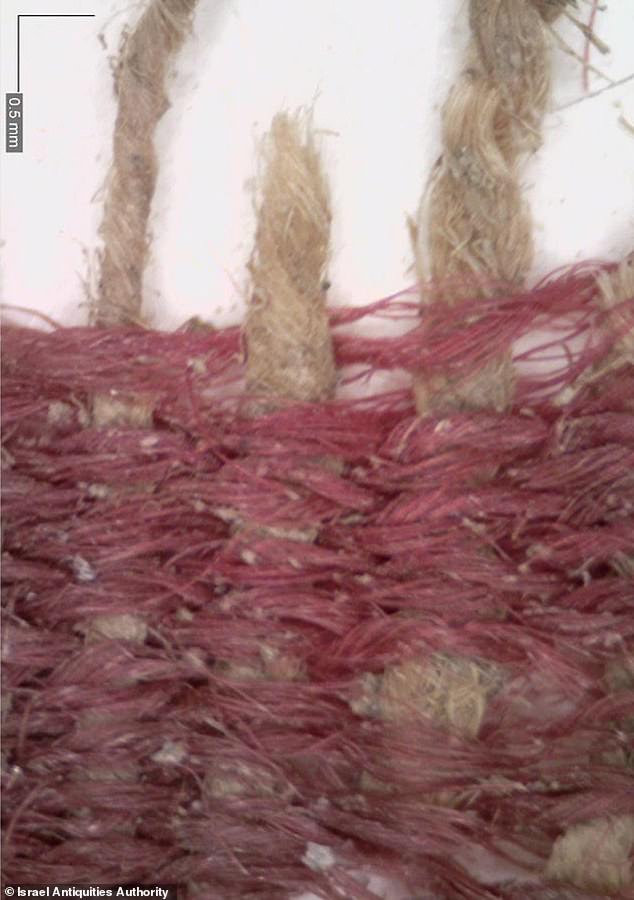

The weft threads had a distinctive shade of bride red, interwoven between the undyed warp threads.
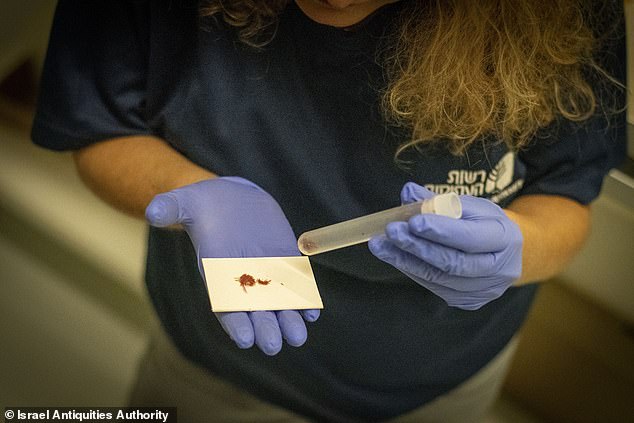
Scientists used the advanced technique of high-performance liquid chromatography (HPLC) to identify the dyes, separating the individual components in a complex mixture through the process of analyzing the compounds dissolved in a liquid sample.
They then compared their findings against a database with established chemical standards, which included kermesic acid, a chemical produced by these insects.
The textile was dated to the Middle Bronze Age (approximately 15th to 16th century BC) using carbon-14 analysis.
Dr. Naama Sukenik from the Israel Antiquities Authority stated: 'This advanced analytical method allowed us to determine the dye's origin down to the exact species of scale insect.
'Consequently, we can conclude with a high degree of certainty that in ancient times, the textile was dyed using a species of the Kermes vermilio insect, which generates kermesic acid, resulting in its distinctive bright red color.'
Professor Zohar Amar of Bar-Ilan University stated: "The term 'worm' in ancient times was a general term for a range of insects and their growth stages.
The Biblical association with a living creature shows remarkable knowledge of zoology, given that female scale insects possess neither legs nor wings, with some ancient naturalists in Greece and Rome even believing them to be plant granules.
Throughout history, various species of scale insects have been used to produce a variety of crimson and red dyes.
"To this day, people in South America use another species of cochineal scale insect that lives on certain types of cacti to dye fabrics.
Despite the overwhelming written historical records of the use of insect-sourced dyes in ancient times, only a handful of textiles dyed with kermes insects dating before the Roman era have been discovered to date worldwide.
This significant discovery helps to bridge the gap between written records and archaeological findings, providing proof that the ancient textile dyeing industry was fully developed and already using animal-based dyeing methods at this point.
This rare textile serves as evidence of extensive commercial networks operational on an international level even back then, and it suggests the existence of a high-end society.
Read more
Join the conversation