Talk about vintage! Scientists extract DNA from world's oldest cheese
A good vintage cheddar is a must-have selection on any respectable cheese platter.
While most types of cheese are aged for approximately one year, this is significantly short of the world's oldest cheese, which has an age dating back to around 3,600 years.
.
Researchers have successfully isolated the DNA of the cheese in order to identify its primary constituents.
Their analysis suggests that the ancient cheese was made from kefir, a fashionable fermented milk drink that is excellent for gut health.
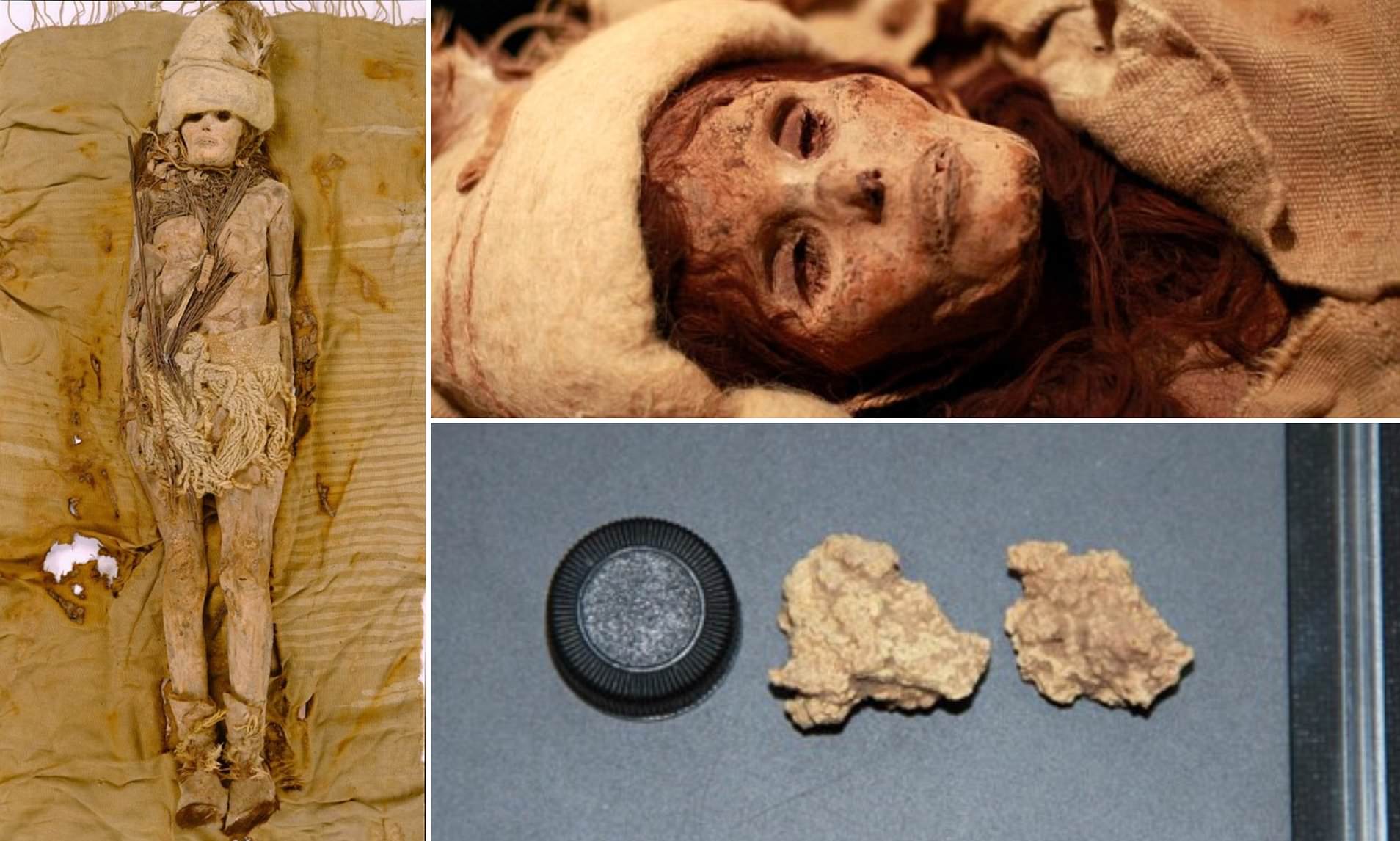
Approximately twenty years ago, a group of archaeologists encountered enigmatic white substances applied to the heads and necks of several mummies unearthed in the Xiaohe cemetery located in the Tarim Basin in northwestern China.
The mummies are estimated to be around 3,300 to 3,600 years old, dating back to the Bronze Age period.
The prevailing theory among scientists at the time was that these substances could be a type of fermented dairy product, although the precise classification remained unclear.
Now, Making use of cutting-edge DNA analysis, researchers have finally cracked the code.
They identified DNA from cows and goats in the cheese samples, confirming that the white substances were actually kefir cheese.
The samples from three different tombs contained species of bacteria and fungi, including Lactobacillus kefiranofaciens and Pichia kudriavzevii - both commonly found in modern-day kefir grains.
Kefir grains are aggregations of microorganisms consisting of various probiotic bacteria and yeast species, which ferment milk into kefir cheese.
In addition to enhancing the beneficial bacteria in our digestive systems, kefir is believed to be beneficial for bone health, reducing blood sugar levels and enhancing heart health.
"This is the oldest known cheese sample ever discovered in the world," said Professor Qiaomei Fu, leader of the ancient DNA laboratory at the Chinese Academy of Sciences.
It's no easy task to preserve food items like cheese for thousands of years, making this discovery a rare and highly prized find.
'Examining the ancient cheese in considerable depth can aid us in comprehending our forebears' diet and way of life.'
Sequencing the bacterial genes found in the ancient kefir cheese allowed the research team to trace the evolution of probiotic bacteria over a period spanning 3,600 years.
Their research contradicts the long-held assumption that kefir originated only in the North Caucasus mountain region of Russia.
This supports the theory that kefir culture has been preserved in Northwestern China's Xinjiang region since the Bronze Age.
Research has shown that, compared with ancient kefir bacteria, modern kefir is less likely to initiate an immune response in the human intestine, thereby making it easier to digest.
'This is an unusual study, enabling us to observe how a bacterium has changed over the past 3,000 years,' Professor Fu stated.
'By examining dairy products, we've gained a more detailed understanding of ancient human life and their relationships with their environment.'
Today, kefir products consist of beverages, yogurts, and ice cream.
According to the research reported in the scientific journal Cell.
Read more
Join the conversation